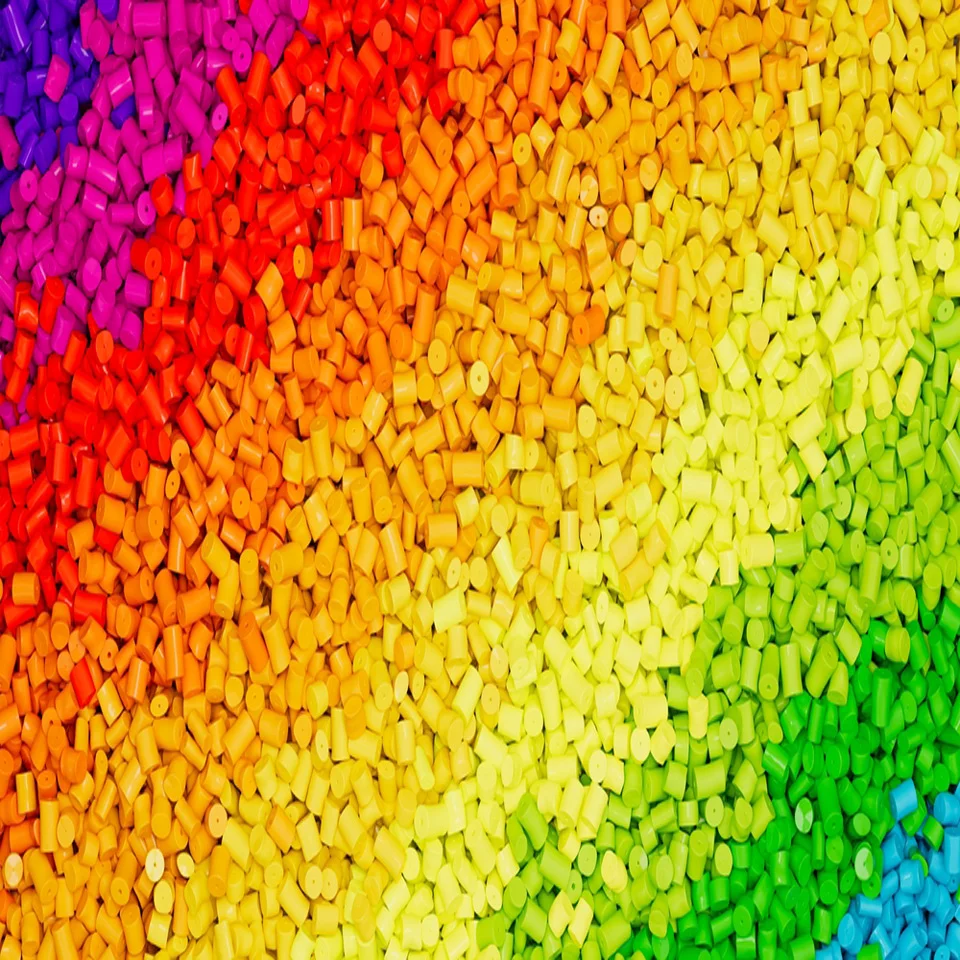
In the plastics industry, color masterbatch is a concentrated mixture of pigments and/or additives encapsulated during a heat process into a carrier resin, which is then cooled and cut into a granular shape.
Essentially, it is a “color concentrate” that allows manufacturers to color raw polymer (plastic) efficiently and cleanly during the molding or extrusion process.
1. How It Works: The “Squash” Analogy
Think of raw plastic resin as water and masterbatch as highly concentrated fruit squash. You only need a small amount (typically 1% to 5%) to change the color of the entire batch.
The Mix: Small pellets of masterbatch are mixed with “natural” (uncolored) plastic pellets.
The Melt: Both are fed into a machine (like an injection molder or extruder).
The Result: The heat melts the carrier resin, releasing the pigments and dispersing them evenly throughout the plastic to create a uniform final color.
2. Key Benefits
Using masterbatch is generally preferred over using raw powder pigments for several reasons:
Cleaner Production: Powders create dust that can contaminate the factory and pose health risks. Masterbatch is dust-free.
Better Dispersion: Pigments are already “pre-dispersed” in the carrier resin, which prevents streaks or spots in the final product.
Dosing Accuracy: It is much easier to weigh and measure solid pellets than fine powders or liquid dyes.
Storage Efficiency: Manufacturers can buy large quantities of cheap “natural” resin and keep a small stock of different masterbatches to create any color they need on demand.
3. Types of Masterbatches
While “Color” is the most common, there are several specialized types:
| Type | Purpose | Common Uses |
| :— | :— | :— |
| White | High opacity and brightness (using $TiO_2$). | Food packaging, medical devices. |
| Black | Deep black color and UV protection. | Agricultural films, pipes, cables. |
| Special Effect | Aesthetics like metallic, pearlescent, or “glow-in-the-dark.” | Cosmetics, toys, luxury packaging. |
| Additive | Adds functional properties (Anti-static, UV stabilizer, Flame retardant). | Outdoor furniture, electronics. |
4. The Production Process
Formulation: Determining the exact ratio of pigments, additives, and carrier resin.
Mixing: Raw ingredients are combined in a high-speed mixer.
Extrusion: The mixture is melted and pushed through a twin-screw extruder to ensure the pigments are perfectly distributed.
Pelletizing: The molten plastic “strands” are cooled in water and chopped into the final pellets you see in the industry.
Comparison: Masterbatch vs. Pre-colored Resin
Masterbatch: You mix it yourself. It’s cheaper and offers more flexibility with inventory.
Pre-colored Resin: The plastic arrives already colored. It is easier to use but more expensive and requires storing large volumes of specific colors.